Hi-fi, short for high fidelity, is about sound that feels real — clear, detailed, and faithful to the original recording. At its core, it’s an attempt to reproduce music in a way that makes you feel like you’re right there in the room where it was created. That pursuit has shaped a deeply passionate, detail-oriented, and global community of listeners.
High fidelity technically refers to audio systems that reproduce sound with very little distortion, a wide frequency range (roughly 20Hz–20,000Hz, what the human ear can hear), and minimal background noise. High fidelity is about immersion. It’s hearing the subtle space between instruments, the way a note lingers in a room, or the breath a singer takes before a line.
An introduction to high-fidelity sound
History
The idea of “high fidelity” became widely known in the 1950s, but the effort to reproduce sound accurately goes back earlier. Engineers at Bell Laboratories in the 1920s and 30s were among the first to measure things like distortion and frequency response in recorded audio.After World War II, home audio took off. The late 1940s and 50s introduced stereo LPs, more accessible amplifiers, and speakers designed for accurate playback. Companies like McIntosh, JBL, Marantz, and Klipsch helped define this era.
In Japan, hi-fi developed its own distinct culture. Listening cafés known as jazz kissa became popular in postwar Tokyo, giving people access to high-quality sound systems they couldn’t afford themselves. By the 60s and 70s, these spaces had grown into a nationwide phenomenon, built around careful listening and deep respect for the music. That spirit carries through today in listening bars across cities like New York, London, and Berlin.
Our sound
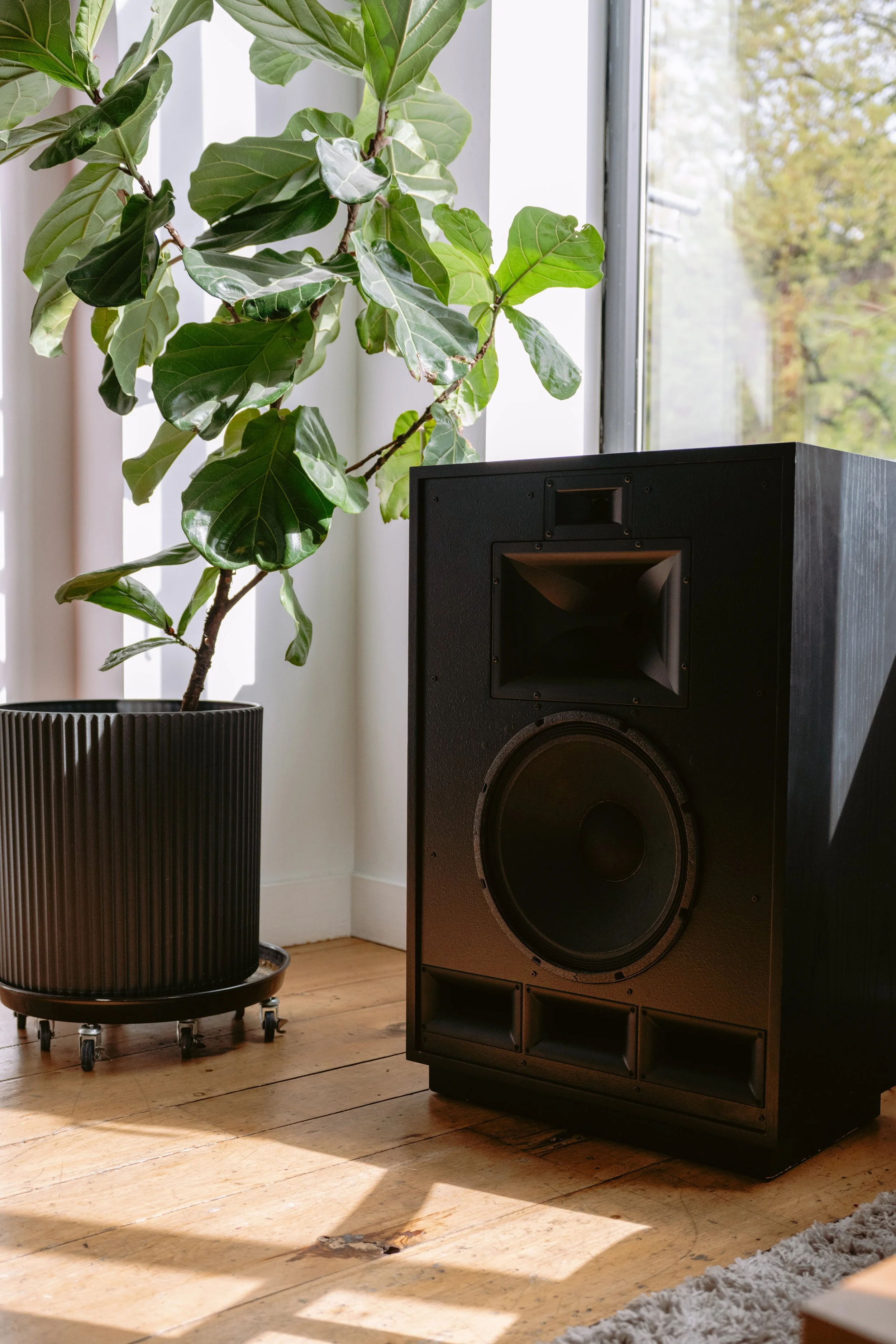
Our sound system is a carefully curated collection of vintage and modern hi-fi equipment, chosen for character as much as performance. At its heart is the Klipsch Cornwall IV — a floor-standing speaker that traces its lineage back to 1946, delivering 102 dB of sensitivity through a three-way horn-loaded design that fills any room with effortless, concert-hall presence. Driving it all is the Monteverdi Model H315, a rare and beautifully built AM/FM stereo receiver from the late 1970s putting out 140 watts of warm, musical power — part of Lloyd's short-lived high-end Monteverdi line, inspired by the golden age of American hi-fi. Records are spun on the Technics SL-1200MK2, the quartz-locked direct-drive turntable that became the industry standard in 1979 and has never been surpassed for speed stability and build quality. Together, these three pieces represent the best of analog audio — built to last, built to be heard.
Klipsch Cornwall IV
Year2019
Sensitivity102 dB
Freq.30Hz – 20kHz
Power100W continuous
Impedance8 Ohms
Woofer15" cast frame
Config3-way horn
Monteverdi Model H315
YearLate 1970s
Power70W per channel
Total140W RMS
TunerAM / FM Stereo
InputsPhono, Aux, Tape
OutputHeadphone jack
BrandMonteverdi by Lloyd's
Technics SL-1200MK2
Year1979
DriveDirect drive
Speeds33⅓ / 45 RPM
Wow & Flutter±0.01% WRMS
S/N Ratio78 dB
Pitch±8% / ±16%
TonearmS-shape, static bal.