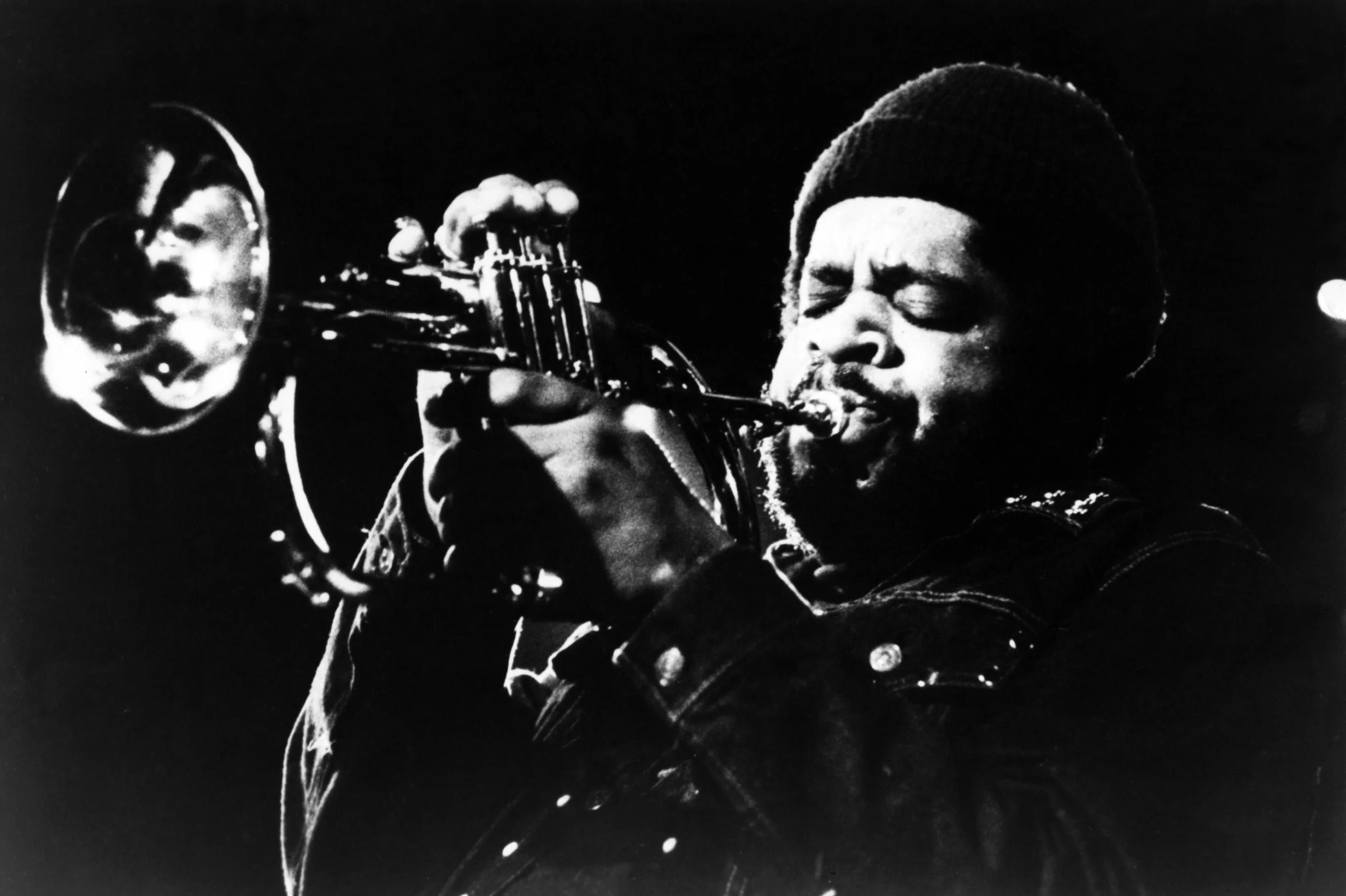
There is a particular kind of American genius that refuses to sit still, and Donald Byrd was built from it. He was born Donaldson Toussaint L'Ouverture Byrd II in Detroit in 1932, the son of a Methodist minister who played music on the side, and from the very shape of his name you can sense a family that understood inheritance as both burden and instruction. Byrd would spend the whole of his life proving that a Black artist did not have to choose a single self and hold it still for the comfort of anybody watching.
He came up through Cass Technical High School and Wayne State University, then the Air Force, then the Manhattan School of Music, and by the time he reached New York in the mid-1950s he was ready. In 1955, at just twenty-three, he joined Art Blakey's Jazz Messengers, called in to fill the chair left empty by the death of Clifford Brown, a trumpeter whose loss had left the whole of the music in mourning. To be asked to follow Brown was to be handed a kind of impossible inheritance, and Byrd carried it not by imitation but by becoming, in short order, one of the defining hard bop trumpeters of the post-Brown era: a clean, biting tone, a lyricism that never softened into sentiment, a stream of Blue Note sessions as leader and sideman that ran through the finest company jazz had to offer. He played beside Coltrane, Rollins, Monk, Max Roach. He built, alongside baritone saxophonist Pepper Adams, one of the great partnerships of the era, eight albums cut together across a decade.
But Byrd was never only a horn player, and this is where his story becomes instructive rather than merely admirable. He went back to school again and again, a master's from Manhattan, a law degree from Howard, eventually a doctorate in education from Columbia, and he carried all of that learning into classrooms at Rutgers, Hampton, Howard, North Carolina Central. At Howard, as chairman of the Black Music Department, he did something few musicians of his stature ever bother to do: he took his own students seriously as collaborators rather than disciples. He gathered a handful of them, Kevin Toney, Keith Killgo, Joe Hall, Allan Barnes, Barney Perry among them, and in 1973 he brought them into the sound of Black Byrd, an album built with producers Larry and Fonce Mizell that fused hard bop discipline to funk and soul and something like gospel testimony. The jazz critics who had once praised him called it a betrayal. The record did not care. It became the best-selling album in Blue Note's history, and out of its success those same Howard students formed their own group, the Blackbyrds, and carried Byrd's teaching into the charts under their own name.
This is, I think, the truest measure of the man. A teacher who builds a stage and then steps to the side of it is rarer than the culture tends to admit, and Byrd did this more than once. He would later say of himself that he was creative and not recreative, that he had no interest in repeating what everyone else was already doing, and whatever you make of the phrase, the discography backs it up. His recordings from the 1970s, Street Lady, Stepping Into Tomorrow, Places and Spaces, would go on to be sampled across more than two hundred hip-hop records, which means that a whole generation of listeners who never once cracked open a Blue Note sleeve have nonetheless danced inside Donald Byrd's sentences without knowing his name. That is its own kind of immortality, the anonymous kind, the kind that asks nothing of the audience but a beat they cannot help but move to.
He died in February of 2013, eighty years old, having already been named an NEA Jazz Master more than a decade earlier. What he left behind was not simply a catalog but a method: study everything, defer to no one's expectations of you, and when you have learned something worth knowing, hand it to the young people standing closest to you and get out of their way.
. . .
Cue the Record will host a listening session of Donald Byrd's Places and Spaces on September 6th at 4:30 PM, presented by Mustafa Ali-Smith and Dr. Bruce Campbell Jr., aka DJ Junior of Record Breakin' Music.